


The Story of Herbert Kilpin: The Founding Father of AC Milan (1870-1916)
1. Introduction: The English Pioneer of Italian Football
Who Was Herbert Kilpin?
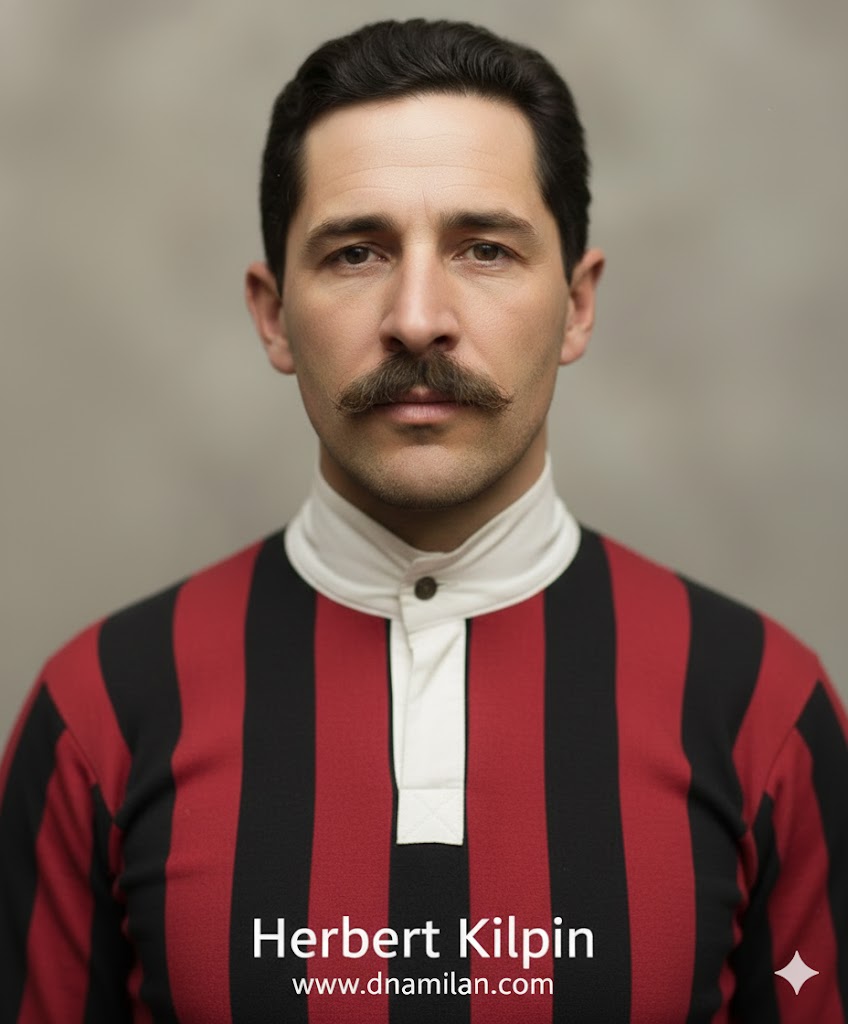
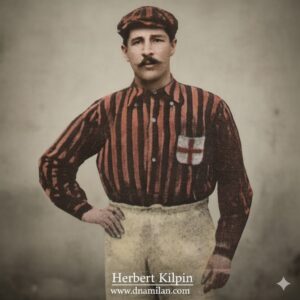
Herbert Kilpin (1870-1916) stands as one of football’s most transformative figures, yet for much of the 20th century remained one of its most forgotten heroes. Born in Nottingham, England to a butcher’s family, Kilpin would eventually become the founding father of AC Milan, one of the world’s greatest football clubs. His journey from a Nottingham lace worker to the visionary who established Milan’s iconic red and black identity represents one of football history’s most remarkable narratives.
Kilpin’s significance extends beyond merely founding a club. He was the first Englishman to play football abroad, pioneering the international movement that would transform football into a global phenomenon. His role in establishing football in Italy, both through his time in Turin and subsequently in Milan, fundamentally shaped the development of Italian football itself.
2. Early Life in Nottingham (1870-1891): The Foundation
Birth and Family Background
Herbert Kilpin was born on January 24, 1870, at 129 Mansfield Road in Nottingham, England (later renumbered to 191). His father was a butcher, and Herbert was the youngest of ten children, growing up in a working-class household during the height of Victorian industrial England. Nottingham was then one of England’s most prosperous cities, the center of the nation’s lace manufacturing industry—a prosperity that provided the economic foundation for Kilpin’s family.
Youth and Early Career
Following formal education, young Herbert entered the textile industry, working as a lace warehouse assistant. This employment connected him directly to Nottingham’s dominant economic sector. The experience provided him with work discipline, understanding of industrial organization, and the practical knowledge that would later prove invaluable when establishing an organization in Italy. More importantly, it gave him the independence to pursue his passion: football.
Introduction to Football
From an early age, Kilpin was a keen footballer. At age thirteen, he helped found a small amateur club, naming it after Giuseppe Garibaldi, the Italian nationalist hero. The choice of Garibaldi’s name and the club’s red shirts proved prophetic—years before Kilpin ever moved to Italy, he was already inspired by Italian history and culture. He played near Nottingham’s Forest Recreation Ground and the Arboretum, developing his skills in the local football community.
Kilpin progressed through amateur football, playing for Notts Olympic and St. Andrews, a church team near Forest Recreation GroundEnglish football, he developed the tactical understanding and love for the game that would define his life’s work.
3. The Italian Journey Begins: Turin Years (1891-1897)
Moving to Italy for Textile Work
In 1891, at age twenty-one, Herbert Kilpin made a transformative decision: he emigrated to Turin, Italy. The move was facilitated through employment with Edoardo Bosio, an Italian-Swiss textile merchant. The connection came through Thomas Adams, a Nottingham lace manufacturer. The textile trade links that connected Nottingham to Northern Italy provided the pathway that would alter Kilpin’s life and subsequently reshape Italian football.
Internazionale Torino: The First Italian Football Club
Edoardo Bosio, who employed Kilpin, founded Internazionale Torino in 1891—believed to be the first fully-fledged Italian football club. Kilpin joined immediately, becoming the first Englishman to play football abroad. This distinction placed him at the forefront of football’s internationalization. While English players would eventually populate clubs across Europe, Kilpin was the pioneering individual who demonstrated that English football could be successfully transplanted to foreign soil.
Multiple Turin Clubs and Championship Experience
Kilpin spent approximately eight years in Turin (1891-1897), playing for multiple clubs including Internazionale Torino and Torino Football & Cricket Club. His versatility allowed him to play in various positions, and his presence in Turin made him familiar with elite Italian football. Most importantly, he participated in the first two editions of the Italian Football Championship, losing both finals to Genoa. These defeats proved instructive: Kilpin learned what separated championship teams from merely competitive clubs.
4. Founding AC Milan (1897-1899): The Visionary’s Dream
Moving to Milan
In 1897, Herbert Kilpin relocated from Turin to Milan for work, settling with fellow Englishman Samuel Richard Davies. Initially, Kilpin maintained his football involvement by traveling back to Turin on weekends to play for Internazionale. However, the commuting proved exhausting, and Kilpin grew increasingly tired of missing Milan’s social and sporting life. A thought crystallized: why not establish a football club in Milan itself?
The Historic Foundation Meeting
In December 1899, Herbert Kilpin and Samuel Richard Davies gathered a group of English expatriates and Italian businessmen to establish what would become AC Milan. The exact date remains historically contested—the club claims December 16, 1899, though evidence suggests either December 13 or December 18. The ambiguity stems from the loss of the original club charter.
The meeting likely occurred at either the Fiaschetteria Toscana tavern or the elegant Hotel du Nord et des Anglais in Milan. The location symbolized the expatriate community’s gathering place in Milan’s heart, near the famous Galleria Vittorio Emanuele II.
The Original Name and Structure
The club’s original name was Milan Foot-Ball and Cricket Club—reflecting the Victorian convention of establishing multi-sport organizations. Alfred Edwards, a former British vice-consul with standing in Milanese high society, was elected as first president. Kilpin, leveraging his eight years of Italian football experience, was appointed player-manager. David Allison was designated captain for the first season. Edward Berra managed the cricket section.
The Famous Devil Quote and Colors
This legendary declaration, attributed to Herbert Kilpin, encapsulated his vision for the club. The red represented fire: passion, energy, and fiery intensity. The black embodied fear: the psychological intimidation that AC Milan would instill in opponents. The choice was not merely aesthetic—it carried profound philosophical and psychological meaning.
Notably, Kilpin had named his teenage football club in Nottingham after Giuseppe Garibaldi with red shirts. Now, in Italy, he combined that red with black to create the distinctive identity that would endure for over 125 years. The red and black stripes became permanent, unchanging since 1899—a testament to Kilpin’s vision remaining eternally valid.
5. Player-Manager Era: Building a Dynasty (1899-1907)
First Season Leadership and Success
In the inaugural 1899-1900 season, Kilpin managed AC Milan while simultaneously playing. He appointed David Allison, the most experienced player, as captain. This delegation reflected Kilpin’s understanding that leadership extended beyond himself—he needed lieutenants on the field while he focused on tactical direction.
The results were extraordinary. Within months of foundation, AC Milan won the Medaglia del Re (King’s Medal) trophy on May 27, 1900, defeating Juventus 2-0 at Arena Civica in Milan. This victory established the winning mentality that Kilpin envisioned from day one.
Playing Style and Personal Characteristics
Kilpin was described as a portly figure—not physically imposing, yet possessed of exceptional football intelligence. He played every position during his career, demonstrating tactical versatility. While he would never be considered an elite English player, his deep tactical knowledge from eight years in Italian football made him the perfect choice to build a championship team in Milan.
Famous for his colorful personality, Kilpin enjoyed drinking and socializing. A legendary story claims he kept a bottle of whisky in a hole behind the goal, joking that it was “to soften the blow when opposition scored.” While his revelry was noted, it never compromised his competitive excellence or tactical acumen.
Championship Success: 1901, 1906, and 1907
Under Kilpin’s leadership, AC Milan won the Italian Football Championship three times: 1901, 1906, and 1907. The 1901 victory was particularly symbolic—defeating Genoa 3-0 on May 5, 1901 at Ponte Carrega. This meant sweet revenge against Genoa, who had defeated Kilpin’s Turin teams in the championship finals years earlier.
By winning three championships in seven years, Kilpin established AC Milan as Italy’s dominant force. This rapid success from a club founded in December 1899 was unprecedented.
6. Personal Life and Character: The Colorful Pioneer
Life as an English Expatriate in Italy
Herbert Kilpin spent the most formative years of his adult life as an expatriate in Italy. From 1891 onwards, he lived in Turin and Milan, adapting to Italian culture while maintaining his English identity. He was part of a small community of English expatriates in Milan—textile workers, businessmen, and sports enthusiasts who created their own social circles while integrating into Milanese society.
Personality and Reputation
Kilpin was known for his charismatic personality, vibrant character, and love of social engagement. He balanced serious football work with jovial sociability, earning respect from both English colleagues and Italian counterparts. His ability to bridge cultures—understanding English football traditions while embracing Italian passion—made him uniquely suited to his pioneering role.
7. Death and the 82-Year Mystery (1916-1998)
Death in October 1916
Herbert Kilpin died on October 22, 1916, at age 46. The cause of death remains unknown—a mystery that adds to the tragic irony of his story. He died in poverty and relative obscurity, despite having founded one of football’s greatest institutions. The year of his death (1916) coincided with World War I, a time when Milan and Italy were consumed by the broader tragedy of global conflict. Kilpin’s passing received minimal public attention.
The Forgotten Years: 1916-1998
Kilpin was initially buried in the non-Catholic section of Cimitero Maggiore (Municipal Cemetery) in Milan—a location reserved for Protestants and non-Catholics. When his grave concession expired after the initial period, an anonymous benefactor paid to prevent the dispersal of his remains, allowing him to be moved to a small anonymous burial recess (celletta). The identity of this benefactor remains unknown.
For eighty-two years—from 1916 to 1998—Herbert Kilpin lay in this anonymous, unmarked grave. During those decades, AC Milan grew into one of the world’s greatest football clubs, winning championships, European cups, and establishing itself as a global institution. Yet the club’s founder remained completely forgotten, his grave unmarked and unknown.
Adding to the historical irony, Kilpin was recorded in cemetery archives as “Alberto Kilpin” rather than “Herbert“—an administrative error that further obscured his identity.
8. Rediscovery and Proper Recognition (1998-Present): Justice Delayed
Luigi La Rocca’s Historical Investigation
In 1998, amateur historian Luigi La Rocca embarked on an investigation to locate Herbert Kilpin’s grave. After months of searching through municipal cemetery archives, La Rocca made a remarkable discovery: records listing “Alberto Kilpin” with birth and death dates matching Herbert Kilpin exactly. The administrative error had obscured the founder’s final resting place for 82 years.
La Rocca reported his discovery to the Gazzetta dello Sport newspaper, sparking renewed interest in Kilpin’s story. This revelation occurred fortuitously as AC Milan approached its centenary celebration in 1999.
1999: Relocation to Monumental Cemetery
In response to La Rocca’s discovery, AC Milan took action befitting their founder’s importance. In 1999, Kilpin’s remains were relocated from the anonymous non-Catholic section of Cimitero Maggiore to Cimitero Monumentale (Monumental Cemetery)—Milan’s most prestigious burial ground reserved for distinguished citizens. AC Milan paid for a proper tombstone, finally providing the founder with appropriate recognition.
The timing coincided with the club’s centenary celebration, allowing Kilpin’s story to be rediscovered and honored as part of AC Milan’s historical narrative.
2024: Final Honor – The Famedio Crypt
In December 2024, during celebrations of AC Milan’s 125th anniversary, Herbert Kilpin received the ultimate honor: relocation to the Famedio Crypt at Cimitero Monumentale. The Famedio is Milan’s Hall of Fame—an elite section reserved for the city’s most distinguished historical figures.
This placement alongside Milan’s greatest cultural and historical figures represents complete vindication. Kilpin’s grave concession is now permanent, ensuring eternal recognition as a foundational figure in Milan’s history. No longer temporary, no longer anonymous—Herbert Kilpin is finally honored as his legacy demands.
9. Legacy and Impact: The Eternal Rossonero
Creator of Club Identity
Herbert Kilpin created AC Milan’s visual and philosophical identity that endures unchanged over 125 years later. The red and black stripes remain instantly recognizable worldwide. The devil symbolism and Rossoneri nickname originated directly from his vision. The competitive philosophy—winning tournaments in the club’s inaugural season—established a mentality that persists through modern AC Milan.
Pioneer of Italian Football
More broadly, Kilpin pioneered Italian football’s development. As the first Englishman to play football abroad, he demonstrated that English football expertise could be successfully transplanted to foreign cultures. His work in both Turin and Milan helped establish football as Italy’s dominant sport. His tactical knowledge and organizational principles informed how Italian football developed.
Recognition in Nottingham
In Nottingham, Kilpin’s birthplace, a blue heritage plaque marks 191 Mansfield Road (originally 129 Mansfield Road), commemorating his birth and his founding of AC Milan. Local historical societies have celebrated Kilpin’s connection to both Nottingham and Milan, recognizing how a working-class English lace worker became a football legend.
10. Conclusion: From Forgotten to Immortalized
The Journey from Obscurity to Honor
Herbert Kilpin’s story represents one of football history’s most poignant narratives: a visionary who created something magnificent, only to be forgotten for most of his legacy’s existence. Born in Nottingham to a butcher’s family, he rose to establish one of the world’s greatest football institutions. He died in poverty at age 46, his grave unmarked and unknown. For 82 years, AC Milan flourished while its founder remained anonymous in an unmarked cemetery.
Yet his vision proved eternal. The red and black colors he envisioned have been worn by every AC Milan player for 125+ years. The devil symbolism he created remains central to the club’s identity. The winning mentality he established in the club’s first season—winning a trophy within months of foundation—became the standard for all subsequent generations.
Living Legacy in Modern AC Milan
Every time an AC Milan player pulls on the red and black striped jersey, they honor Herbert Kilpin’s vision. Every championship, every European trophy, every moment of competitive excellence traces back to the principles Kilpin established in 1899. The club’s international character—combining multiple nationalities in pursuit of excellence—reflects Kilpin’s original multinational founding squad.
The Eternal Rossonero
Herbert Kilpin is now eternally honored in AC Milan’s story. No longer forgotten, no longer anonymous, he rests in the Famedio Crypt at Cimitero Monumentale alongside Milan’s greatest historical figures. His grave is visited by fans, historians, and supporters who recognize the extraordinary debt they owe to this English pioneer.
From Nottingham lace worker to Italian football legend to Milan’s Hall of Fame: Herbert Kilpin’s journey reminds us that vision, determination, and courage can create legacies that outlive the creator by generations. The Rossoneri will forever carry his mark—red like fire and black like the fear he promised to invoke in opponents. For AC Milan, for Milan the city, and for football itself, Herbert Kilpin remains eternally significant.


all the time i used to read smaller content that as well
clear their motive, and that is also happening with this paragraph which I am
reading at this place.
This post will assist the internet viewers for building up new website
or even a blog from start to end.
nc2ekc